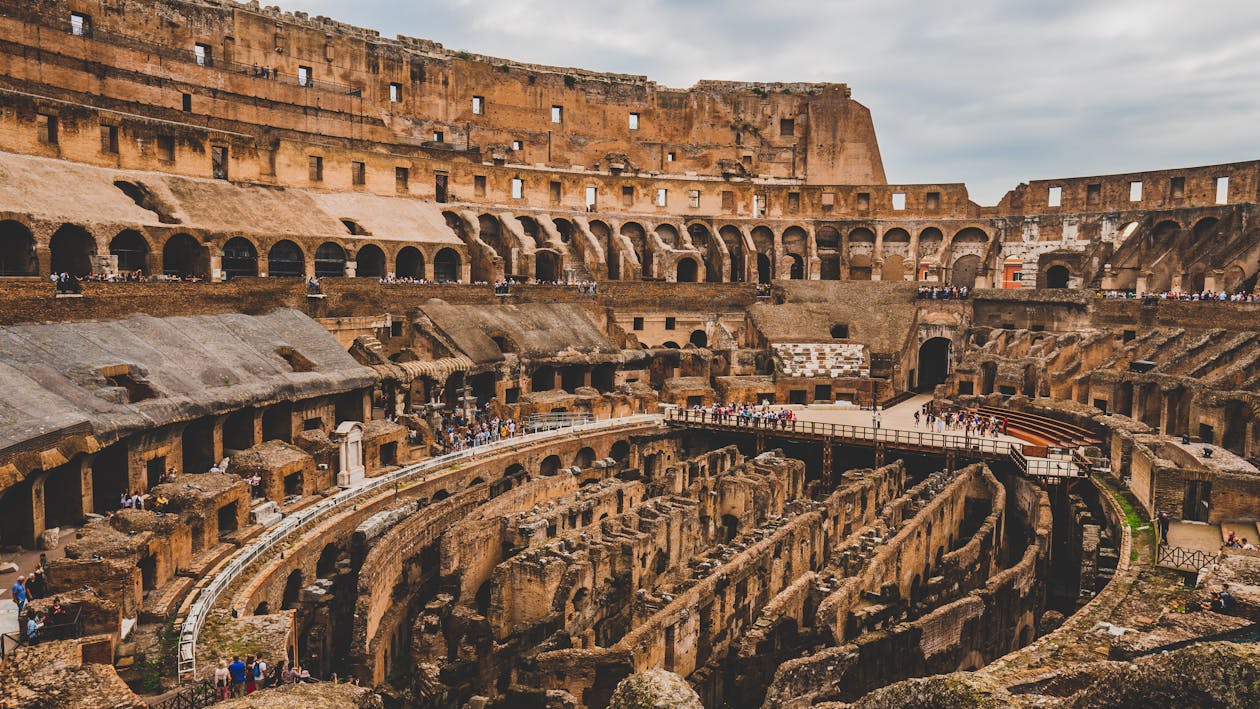
To avoid losing anyone’s attention span, I will assert that today’s post will be the last discussion regarding the Colosseum for a while. Could I write more about this breathtaking historical site? Absolutely. But I don’t want to beat a dead horse, so to speak.
Yesterday’s post detailed what the Colosseum is composed of, and how it came to be one of the most widely recognized structures on planet Earth today. For today’s post, we will be focusing on what specifically the Colosseum was originally intended for. A lot of people are aware it was an amphitheatre, but I’m not entirely certain if the majority of people realize what sort of games took place within these grand walls.
Again, this information comes from britannica.com.
“The amphitheatre seated some 50,000 spectators, who were shielded from the sun by a massive retractable velarium (awning). Supporting masts extended from corbels built into the Colosseum’s top, or attic, story, and hundreds of Roman sailors were required to manipulate the rigging that extended and retracted the velarium. The Colosseum was the scene of thousands of hand-to-hand combats between gladiators, of contests between men and animals, and of many larger combats, including mock naval engagements. However, it is uncertain whether the arena was the site of the martyrdom of early Christians.
“In medieval times, the Colosseum was used as a church, then as a fortress by two prominent Roman families, the Frangipane and the Annibaldi. The Colosseum was damaged by lightning and earthquakes and, even more severely, by vandalism and pollution. All the marble seats and decorative materials disappeared, as the site was treated as little more than a quarry for more than 1,000 years. Preservation of the Colosseum began in earnest in the 19th century, with notable efforts led by Pius VIII, and a restoration project was undertaken in the 1990s. It has long been one of Rome’s major tourist attractions, receiving close to seven million visitors annually. Changing exhibitions relating to the culture of ancient Rome are regularly mounted,” the web page explains.
Call it dramatic irony, but seeing as the Colosseum was used as both a church and a space for gladiators to fight literal lions throughout its history, I think it is safe to say that these walls have countless stories to tell.
 ontheedgeofeverything